It has been over a decade since I became a fan of audiobooks. I have had an Audible subscription since 2008 (before it was purchased by Amazon), and during this time, I have listened to hundreds, if not thousands, of books. A few years ago, I wrote about my process of taking cheap CD audiobooks from Amazon and converting them into M4B files. After discovering that it was possible to put these files into Plex on my Mac Mini, it became my best audiobook setup. When paired with the Prologue app, it creates a perfect listening experience that you own and control.
However, creating these M4B files was always a bit tedious without a dedicated application. MP3 files work great for music, but they fail as a collection of files for audiobooks. They lack true chapter support, bookmarks do not work well, and depending on which app you are using, the resume behavior can be problematic. Over the years, I have tried several tools to convert audio files into proper audiobooks, and while some were great, they all lacked a critical feature: the ability to import audiobook metadata.
This is the problem that AudioBo aims to solve. It is a native macOS application that completely simplifies the process of converting audio files into a proper M4B audiobook.
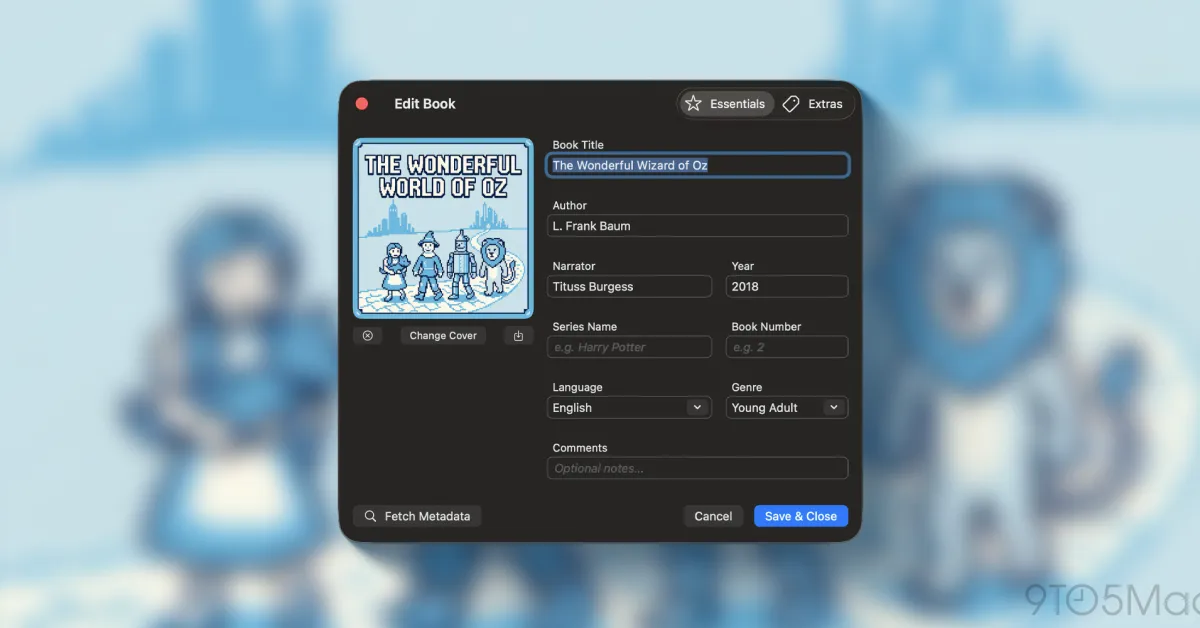
AudioBo makes all the technical decisions for you while creating the books. You can add MP3, FLAC, or WAV files, and the app targets the best quality without taking up all your free space. It writes the correct M4B files (the B in M4A is for bookmarks) and offers full support for QuickTime and Nero chapter formats. This means you get a clean and fully compatible container that works well in Apple Books, Prologue, or any app that can play M4B files.
As I mentioned at the beginning, the key feature for me was metadata imports. With other solutions, I had to find the correct cover, add author information, etc. AudioBo can import metadata from Audible, Apple Books, and Google Books to fill in cover art, book information, and chapter names with a single click. The bulk chapter cleaning tool is also incredible. It allows you to normalize titles, reorder tracks, and remove unnecessary entries from each track without touching them.
Another nice feature is avoiding unnecessary re-encoding. If you only need to update the cover art of an existing M4B file or fix a typo in its title, AudioBo can preserve the original audio stream. There is no quality loss and no time wasted. It simply saves the updated metadata and updates the original file.
After testing AudioBo with a few major audiobook projects, I can confirm that it delivers on its promises and has become my indispensable application for creating audiobooks on macOS.
AudioBo is available for a one-time fee of $9.99 on the Mac App Store, and there is a free demo available on the developer's website.











Comments
(8 Comments)