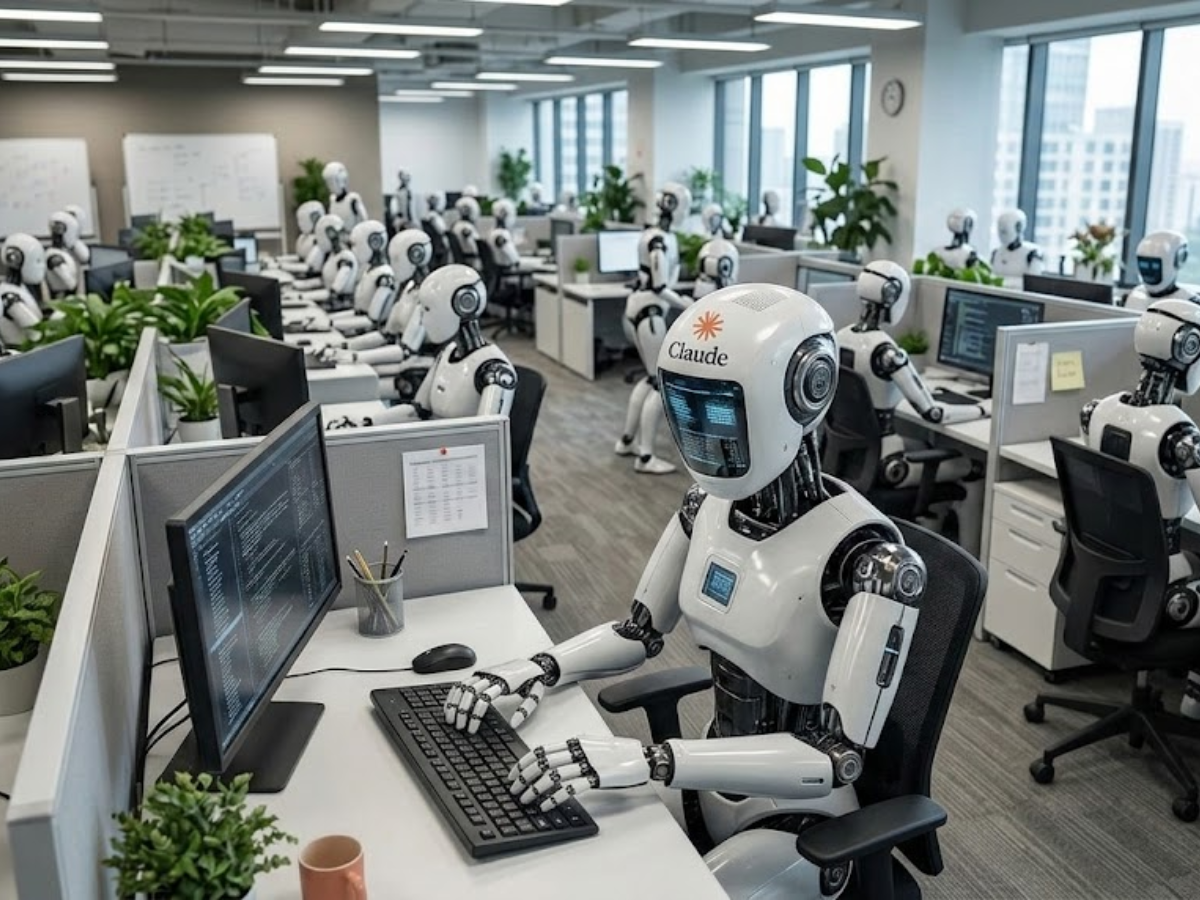
New research from Anthropic reveals how artificial intelligence is affecting jobs in the real world. The company analyzed usage data from the AI assistant Claude and found that some professions are increasingly exposed to automation, while many jobs remain largely unaffected.
During the test, each job was assigned a coverage score. A high score means that AI is practically performing a measurable portion of the tasks in that role, while a low score indicates that the job is least likely to be altered.
The Gap Between AI Capabilities and Real Usage
According to the research, there is a significant gap between what AI can theoretically automate and how companies are currently using it. For example, AI systems could potentially take on up to 90% of the tasks in administrative roles. However, real-world usage data shows that adoption is much lower.
In technology-related fields (the sector most affected by AI so far), observed AI usage covers about one-third of job tasks. This indicates that large-scale job change has not yet occurred, despite rapid advancements in AI tools.
Professions Under AI Pressure
Computer programmers stand out with a coverage rate of 75%, the highest in the dataset. According to the research, Claude's usage in coding emphasizes full automation over efficiency assistance.
Customer service representatives come in second. The core tasks in this role are increasingly becoming visible in first-party API traffic, which researchers define as job routing through AI pipelines.
Data entry workers follow with a coverage of 67%. Financial analysts and office managers are also among the high-exposure professions, but actual adoption in administrative roles lags behind theoretical capabilities.
Data from the Bureau of Labor Statistics cited in the research shows that for every 10-point increase in a job's AI coverage score, the projected workforce growth for that role decreases by 0.6 points by 2034.
30% of US Workers Cannot Be Replaced by AI
Approximately 30% of US workers receive a score of zero. Their tasks do not appear at a meaningful level in AI usage data.
The research defines these as roles based on physical presence, sensory judgment, and real-time situational reading requirements. Among the zero exposure professions listed in the study are chefs, motorcycle mechanics, lifeguards, bartenders, dishwashers, agricultural workers, and court lawyers.
The Bureau of Labor Statistics forecasts stable growth for blue-collar roles over the next decade. According to the research, about 40,000 jobs are added monthly in the healthcare sector, and the demand for nurses, therapists, and caregivers is advancing ahead of AI displacement in these fields.
The Impact of AI May Be Greater on White-Collar Roles
Another surprising finding is that workers most exposed to AI tend to be older, more educated, and higher-paid. Researchers found that employees in roles with AI exposure earn about 47% more than those in jobs with zero exposure.
This is different from previous waves of automation, which typically affected lower-wage jobs first. Instead, AI seems to be targeting tasks commonly found in office-based professions.
Hiring Trends May Already Be Changing
While the research does not find a significant increase in unemployment, early signs of change in hiring patterns are emerging. Among workers aged 22 to 25, the job-finding rate in professions exposed to AI has decreased by about 14% since the launch of ChatGPT at the end of 2022.
Researchers suggest that this may indicate companies are slowing down hiring for roles where AI tools could already assist with key tasks.
The Implications of Findings for People
The data suggests that AI is reshaping tasks rather than eliminating entire professions. Roles that depend on physical skills, human interaction, or real-world environments appear to be much more resilient.
At the same time, office-based professions that are heavily reliant on digital workflows may continue to face increasing automation pressure as AI tools become more capable.
Anthropic describes this index as a first step and plans to update coverage measurements as usage data changes.





![Apple collector showcases 50 years of Mac startup sounds [Video]](/resimler/apple-koleksiyoncusu-50-yillik-mac-acilis-seslerini-sergiliyor-video.jpg)







Comments
(9 Comments)